You are specifying a lid for a cup or tray, and the two terms that keep appearing are aluminum foil lidding film and metallized PET (MetPET) lidding. Short answer: choose foil when you need the highest barrier — near-total oxygen, moisture, and light block — and a proven retort or long-shelf-life seal; choose metallized PET when cost, flex-crack resistance on curved rims, or line speed matter more than absolute barrier. The comparison below shows exactly where each one wins, and the cases section tells you which one your product is.
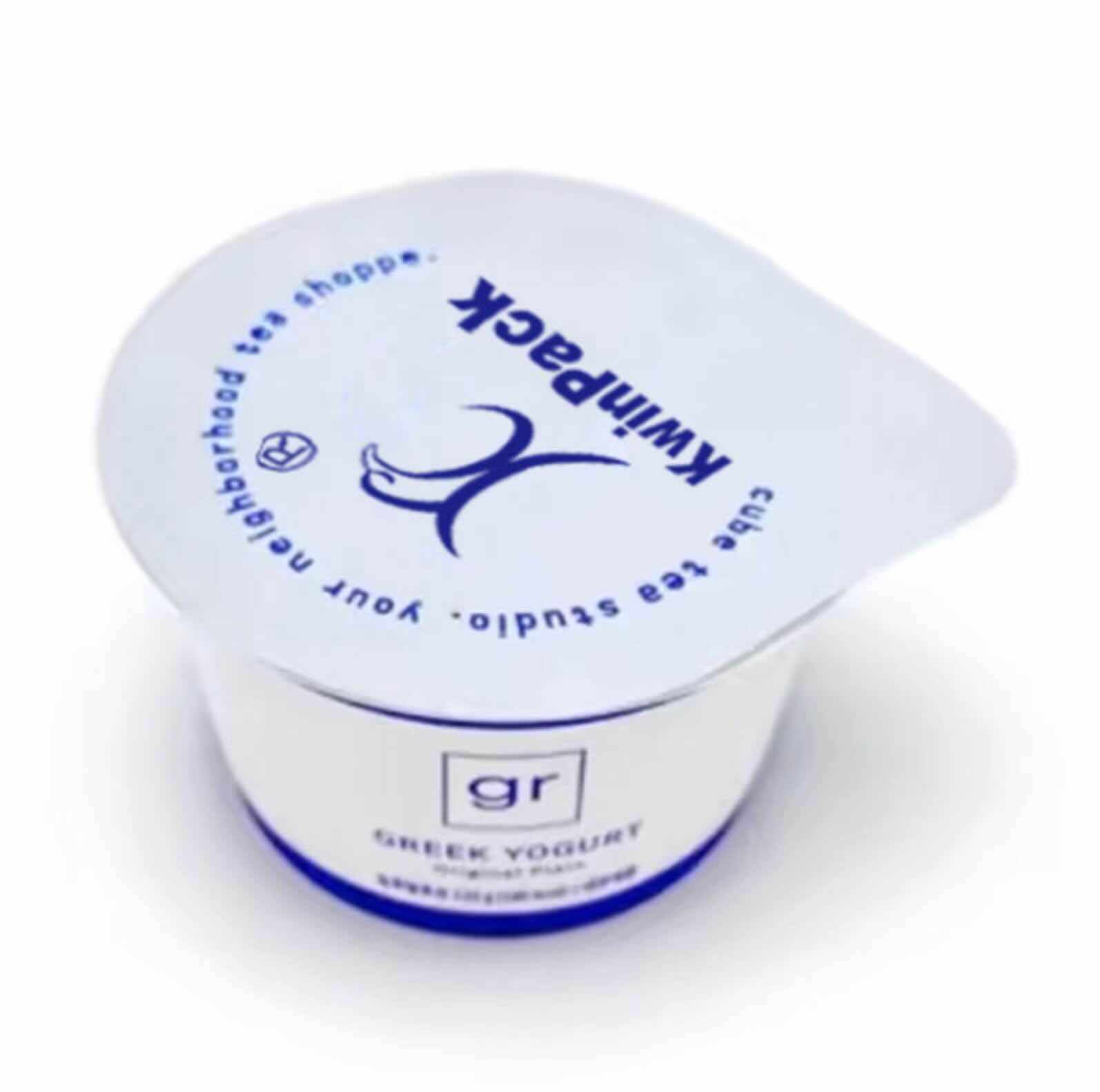
How the two lids are built
Both are printed laminates; the difference is the metal layer.
Aluminum foil lidding — a print layer, an aluminum foil core (commonly 30–50 µm of 8011-O alloy), and a heat-seal lacquer tuned to the cup. The foil is the barrier.
Metallized PET lidding — a print layer, a PET film carrying a vapor-deposited aluminum layer roughly 0.02–0.05 µm thick, and a sealant. Same lamination idea, a fraction of the metal.
Because the metal content differs by orders of magnitude, every property in the next table follows.
The comparison that decides your lid
| Property | Aluminum foil lidding | Metallized PET lidding |
|---|---|---|
| Oxygen / moisture / light barrier | Near-total block; OTR and WVTR effectively near zero | Good but measurable — e.g. a MetPET/PE lid structure typically shows OTR around 1.2 cc/m²·day·atm and WVTR around 0.8 g/m²·day (varies by structure) |
| Light opacity | Fully opaque | High but not total |
| After flexing / on curved rims | Can micro-crack and crease (dead-fold) | Retains barrier better; resists flex-cracking |
| Seal to PP / PS / PET / PE / glass | Heat-seal lacquer matched to the cup; dead-fold conforms to rim tolerances | Also via matched heat-seal lacquer |
| Retort / high-temp (121 °C) | Proven in retort structures | Standard grades limited; retort-grade MetPET is a specialty |
| Microwave | No — metal layer arcs | No — still metal |
| Relative material cost | Higher (solid metal layer) | Lower (minimal aluminum) |
| Recyclability | Mixed-material laminate; generally not curbside-recyclable | Mixed-material; same limitation |
The barrier numbers are typical industry values for specific laminate structures and vary with layer thickness; confirm the exact OTR/WVTR for your proposed lid with the supplier's test data rather than assuming them.
Choose foil lidding when
Shelf life is the business model. Yogurt, dairy, long-life products — where oxygen, light, or aroma loss is measurable in weeks. The same barrier logic is behind our coffee-staling guide.
The pack is retorted or hot-filled. Foil survives the 121 °C sterilization cycle and keeps working for years — see the lidding logic in our retort guide.
Light kills the product. Vitamins, pigments, oils. Foil is the only total light block in the flexible toolkit.
You want a tamper-evident premium first seal. Cosmetic jars and pharma trays use foil's metallic, premium feel — see our pharmaceutical packaging applications.
Choose metallized PET lidding when
6–12 months is enough and budget is the binding constraint.
The lid sits on a curved or flexible rim that gets handled hard in distribution — MetPET resists flex-cracking better than foil.
Line speed or lower seal temperature drives throughput.
Note: MetPET is also not microwave-safe and is also a mixed-material laminate for recycling — it trades barrier, not those limitations.
The honest note most supplier pages skip
In real distribution — dropped cartons, vibrating trucks, crinkled lids — foil laminates can lose more barrier than metallized ones, because foil creases and micro-cracks where MetPET's metal rides on flexible PET. So foil is the right answer for barrier-critical products, not automatically for everything; a curved, handled lid is exactly where MetPET can be the smarter call.
How the seal works (and why it matters for the choice)
Both lids bond through a heat-seal lacquer formulated for the specific cup resin. Seal temperature typically runs 160–220 °C, and consumer easy-peel lids commonly target roughly 3–8 N/15 mm, with weld seals higher at about 8–15+ N/15 mm — typical industry ranges, so set a target and accept samples against it. Foil's dead-fold helps it conform to minor rim tolerances; matching the lacquer to the cup is the real determinant of a clean peel. The cup-by-cup detail is in our seal-layer guide.
Buyer checklist: what to send for a quote
Cup / rim material (PP / PS / PET / PE / glass / co-extrusion).
Rim diameter and geometry, plus samples of your actual cups.
Product and whether it contacts food directly.
Fill temperature and storage (ambient / chilled / pasteurize / retort / freeze).
Opening experience (easy-peel / firm / weld).
Peel-force target if known.
Format — die-cut lids (Ø) or roll stock (width, core ID).
Print colours, finish, embossing.
Quantity range and desired lead time.
Destination market and any compliance documents needed.
At Gerun Pack, custom printed foil lidding starts at 10,000 pieces per design, with typical lead time 15–25 days after artwork confirmation. We run an ISO 9001 quality system and validate food-contact films with FDA-accredited laboratory test reports; request the compliance file for your market when you enquire. A fuller spec-sheet view is in our lidding applications guide.
Frequently asked questions
Is aluminum foil lidding microwave-safe?
No — the metal layer arcs in a microwave. Metallized PET also is not microwave-safe. Microwaveable packs need transparent-barrier lidding, which is a different project.
Which lid is more recyclable, foil or metallized PET?
Neither mixed-material laminate is curbside-recyclable. A mono-material PE lid is the practical recyclable route through store drop-off; we will advise honestly when a structure cannot support the claim you want to make.
Can metallized PET lids be retorted?
Standard grades generally cannot; retort-rated MetPET is a specialty. Foil is the proven retort lidding material.
What peel force should a yogurt lid have?
Consumer easy-peel lids typically target about 3–8 N/15 mm, with weld seals around 8–15+ N/15 mm. These are typical ranges; set a target and accept samples against it on your real cups and line.
Which lid is better for a dairy cup?
Foil for maximum barrier and shelf life; metallized PET where cost and flex-crack resistance dominate. Decide by shelf-life target and distribution stress, not by default.
Next steps
Browse our foil lidding range or a round foil lid and cup / pure silver lid example, read the companion foil vs metallized PET pouch guide for the pouch version of this decision, and request a quote with the checklist above.